



Healthy feet help keep you moving. This May, help us raise awareness about the importance of foot health and preventing foot complications.
Foot problems can affect anyone, but people living with diabetes are at greater risk of developing serious foot complications, including foot ulcers and infections that can lead to limb loss.Diabetes can affect foot health in several ways:
- Nerve damage (neuropathy) can reduce or eliminate sensation in the feet. A person may not feel a blister, cut, burn or other injury that could become a wound.
- Reduced blood flow can make it harder for the body to heal an injury and can increase the risk of complications.
- Changes in vision can make it more difficult to see and care for the feet properly.
The good news is that many foot complications can be prevented or treated successfully when risks are identified early and the right care is provided.
Prevention is a shared responsibility. People living with diabetes and their families and caregivers can build healthy foot-care habits. Health-care providers can screen for risk and act early when problems are identified. Health decision makers can help ensure that people have timely access to the services, professionals and treatments they need.
Everyone has a role to play in keeping Canadians on their feet.
What can you do to raise awareness for Foot Health Awareness Month?
Healthy feet start with regular care and paying attention to changes.
- Check your feet every day. Look for cuts, blisters, redness, swelling, calluses, changes in skin colour or temperature and other signs of injury.
- Protect your feet. Wear properly fitting footwear and avoid walking barefoot, particularly if you have reduced sensation in your feet.
- Know your risk. If you live with diabetes, ask your health-care provider to assess your risk for foot complications and tell you how often your feet should be checked.
- Don't ignore changes. A small foot problem can become serious. If you notice a wound or another change that concerns you, seek advice from a health-care professional.
- Learn how to care for your feet. Wounds Canada has resources to help you and your care partners prevent and manage diabetes-related foot complications.
- Share what you know. Talk with your family, friends and community about the importance of foot health and early action.
Explore:
- Caring for Your Feet: Safe Foot Care if You Have Diabetes
- Diabetic Foot Complications: When is it an emergency?
- The many resources on our website Diabetes, Healthy Feet and You
- Know your rights: The Patient Bill of Rights and Responsibilities
- Patient and caregiver story series: Our Voices, Our Stories
- More diabetes-related foot health resources
Health-care professionals
Prevention, risk screening and early intervention can help reduce the risk of serious foot complications.
- Assess the feet of people living with diabetes and identify their level of risk.
- Educate patients and care partners about daily foot care, appropriate footwear and when to seek care.
- Act promptly when changes or potential complications are identified.
- Use evidence-based approaches to prevent and manage diabetic foot ulcers.
- Support patients in developing practical self-management routines that fit their lives.
- Work collaboratively with other members of the health-care team when specialist assessment or intervention is needed.
Explore:
-
- Best Practice Recommendations for the Prevention and Management of Diabetic Foot Ulcers
- Inlow's 60-second Diabetic Foot Screen
- The many resources on our website Diabetes, Healthy Feet and You
- Wounds Care Canada article “The Importance of Timely Interventions”
- The resources in the patients and caregivers section of this webpage are helpful tools when providing education and instruction to your patients on self-management techniques
Advocates and policy makers
Foot health is also a health-system issue. Prevention and early intervention can reduce avoidable complications, improve quality of life and help prevent unnecessary amputations.
Policy makers and health system leaders can:
- Support access to regular foot screening and preventive care for people at risk.
- Improve timely access to multidisciplinary foot and wound care.
- Support evidence-based prevention and management of diabetic foot ulcers.
- Address financial, geographic and other barriers that prevent people from accessing appropriate footwear, offloading, wound care and other necessary services.
- Use evidence-based care pathways to support consistent, timely care across health systems.
Explore:
Featured interview
Diabetic foot prevention: Dr. Mohamed Magdy Badr on early action, mobility and innovation
What if diabetic foot prevention started before a wound appeared? What if success meant more than wound closure?
In this interview, wound care physician and educator Dr. Mohamed Magdy Badr shares his perspective on diabetic foot prevention, early detection and treatment. He discusses why prevention should begin when diabetes is diagnosed, how social and psychological factors influence outcomes and why preserving mobility and quality of life should be central to diabetic foot care.
He also explores the potential of wearable technology and AI to identify tissue stress before ulceration occurs and shares lessons from military rehabilitation that could strengthen civilian diabetic foot programs.

WC: How do socioeconomic inequalities influence diabetic foot outcomes even before “high-risk” classification develops?
Socioeconomic inequality is one of the most underestimated drivers of diabetic foot complications. Many patients are classified clinically as “low risk,” yet they live in environments that expose them to high practical risk. Limited income may affect their ability to buy protective footwear, attend follow-up visits, access early vascular assessment, or even take time off work when early symptoms appear. A patient may not have neuropathy today, but if they walk long distances in poor footwear, delay care because of cost and lack health education, their real-world risk is already elevated. This is why diabetic foot prevention should not rely only on biological risk factors. It should also include social risk factors such as affordability, occupation, distance from care, education level and family support.
WC: Are current health-care systems too focused on ulcer treatment rather than mobility preservation?
Yes. Many systems still define success as wound closure, but wound closure alone is not enough. A healed ulcer over an unstable foot, poor footwear, persistent deformity, or unresolved ischemia is not true success. It is often only a temporary pause before recurrence. The real goal should be mobility preservation.
This means we should ask:
• Can the patient walk safely?
• Can they return to work?
• Can they wear appropriate footwear?
• Has pressure been redistributed?
• Has recurrence risk been reduced?
• Has the patient regained confidence?
Diabetic foot care should move from a “wound-centred model” to a “function-centred model.”
WC: How can wearable technology and AI reshape early detection of tissue stress before ulceration occurs?
Wearable technology and AI may become major tools in diabetic foot prevention. Many ulcers are not sudden events. They are the final stage of repeated pressure, heat, friction, inflammation and unnoticed tissue stress.
Wearables can help detect:
• Abnormal plantar pressure
• Temperature differences between feet
• Reduced activity or altered gait
• Repetitive stress points
• Early inflammation before skin breakdown
AI can combine these signals with clinical history, footwear data, vascular status, neuropathy status and previous wound history to create a personalized risk profile.
WC: What role does patient psychology play in delayed presentation and poor adherence?
Patient psychology is central. Many patients do not ignore advice because they are careless. They may be afraid, overwhelmed, in denial, embarrassed, financially stressed or simply unable to connect daily foot care with future limb loss.
Common psychological barriers include:
• Low perceived risk
• Fear of diagnosis
• Denial of diabetes complications
• Treatment fatigue
• Depression
• Previous negative healthcare experiences
• Belief that “small wounds heal by themselves”
This is why education should not be delivered as instruction only. It should be delivered as behavior change support. We need empathy, repetition, motivational interviewing, simple routines, family engagement and emotionally meaningful messages. The future is not only detecting ulcers early. The future is detecting pre-ulcerative stress before the wound exists.
WC: Should diabetic foot prevention begin at the diagnosis of diabetes itself rather than after neuropathy develops?
Yes, absolutely. Waiting for neuropathy before starting prevention is like waiting for brake failure before teaching safe driving. The moment diabetes is diagnosed, patients should understand that the foot is a lifelong target organ of diabetes.
Early prevention should include:
• Foot hygiene
• Nail care
• Shoe selection
• Avoiding barefoot walking
• Skin moisturizing
• Early reporting of redness, swelling, blisters, callus, or wounds
• Understanding the danger of minor trauma
The goal is to build habits before complications appear, not after.
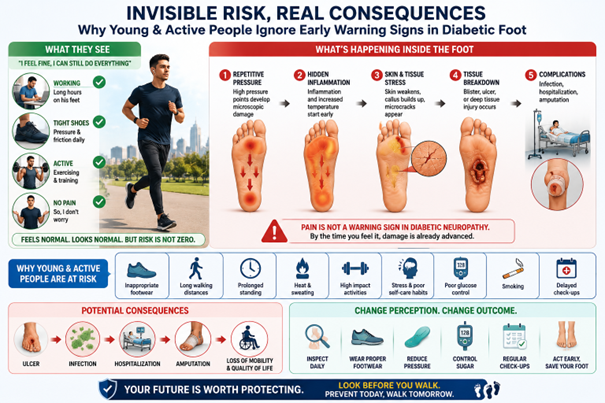
WC: How can digital education, social media, and visual storytelling improve preventive behaviors in younger generations?
Younger patients often respond better to short, visual, repeated messages than traditional clinic leaflets. Digital education can deliver prevention through:
• Short videos
• Infographics
• WhatsApp reminders
• Social media posts
• Patient stories
• Visual warning signs
• Interactive quizzes
• AI-based personalized education
The message must be simple, frequent, emotional and visually memorable. For example, instead of saying: “Inspect your feet daily,” we can say: “Your foot may be injured before it hurts. Look before you walk.” This type of message is easier to remember and more likely to change behavior.
WC: What lessons from military rehabilitation systems can civilian diabetic foot programs adopt?
Military rehabilitation often focuses strongly on function, performance, teamwork and reintegration. Civilian diabetic foot programs can learn several principles:
• Early multidisciplinary involvement
• Clear rehabilitation goals from day one
• Psychological support as part of physical recovery
• Prosthetic and orthotic integration
• Functional outcome measurement
• Return-to-role planning
• Team-based case conferences
The military model reminds us that healing is not the end. Return to function is the mission.
Illustration by Dr. Mohamed Magdy Badr
Support early action
Help make prevention possible.
Preventing diabetes-related foot complications takes more than awareness. It takes education, evidence, resources and timely access to care.
Wounds Canada is a charitable organization dedicated to advancing skin health and excellence in wound management across Canada. Through education, advocacy, research, patient resources and community-building, Wounds Canada works to help prevent wounds before they occur and improve care for people living with wounds.
Your support helps us continue this work.
The Limb Preservation Alliance
Preventing avoidable amputations requires collaboration.
Wounds Canada is proud to be a member of the Limb Preservation Alliance, working alongside national and international organizations to improve awareness, advance education and advocate for better access to limb preservation.
